
NABARD Grade A & B 2025 Exam Pattern, Syllabus, Mock Tests, Books, and Preparation Strategy
Topics Covered: NABARD Grade A & B 2025 Selection Criteria, Exam Pattern (Prelims, Mains & Interview), Grade A & Grade B Syllabus (Phase 1 & Phase 2), Preparation Strategy, Best Books for Grade A & B & Mock Tests
The NABARD Grade A and Grade B exams offer a prestigious opportunity to work with one of India’s leading institutions, responsible for overseeing regional banks across the country.
Clearing these exams requires focused preparation, a well-planned strategy, and consistent effort. Understanding the exam pattern and syllabus is essential to prioritize topics effectively.
The NABARD Grade A exams are conducted in three stages which are; Prelims, Mains, and Interviews.
The syllabus covers a wide range of subjects, including Economic and Social Issues, Agriculture and Rural Development, Reasoning, Quantitative Aptitude, and English. A clear grasp of the syllabus helps candidates plan their study schedule efficiently.
Regular practice with mock tests improves time management and highlights area that need more attention. Along with that, it is also necessary that you choose the right books and study materials to ensure a comprehensive coverage of all topics.
Balancing study sessions with adequate breaks prevents burnout and staying updated on current affairs.
With the right strategy, consistent practice, and effective time management, aspirants can confidently tackle the NABARD Grade A and Grade B exams and maximize their chances of success.
Now, let’s discuss the NABARD Grade A exam pattern, syllabus, mock tests, books, and preparation strategies in details to help you on your path to success.
Table of Content – NABARD Grade A & B Selection Criteria, Syllabus, Mock Test, Books & Preparation
1. Exam Pattern
1.1 Phase I Exam Pattern
1.2 Phase II Exam Pattern
1.3 Interview Selection
1.4 Important points
2. Syllabus
2.1 Phase I Syllabus
2.2 Phase II Syllabus
3. Preparation Strategy
3.1 Study Plan
4. Best Books
5. Mock Tests
5.1 Benefits of Solving Mocks
NABARD Grade A & B 2025 Exam Pattern
Understanding the NABARD Grade A & B exam pattern 2025 is essential for effective preparation. Knowing the structure, types of questions, and marks distribution helps candidates plan their study strategy efficiently.
Let me take you through the various stages in the NABARD Grade A & B exam 2025 that I have mentioned below:
Phase 1 –
- Exam Mode: This exam is conducted online (CBT mode).
- Total Marks: This exam consists of a total of 200 marks for objective-type questions.
- Time Duration: Candidates are given 2 hours to complete the exam.
- Note – Phase 1 acts as a qualifying screening test, and the marks obtained in this stage do not count towards the final selection.
Phase 2 –
- Exam Mode: This exam is conducted online and includes both objective and descriptive sections.
- Total Marks: This phase also consist of a total of 200 marks.
- Time Duration: Candidates are provided with 3 hours and 30 minutes to complete the exam.
- Note – Marks scored in Phase 2 are combined with Interview marks to prepare the final selection list.
Interview –
- Conducted By: The interview is conducted by a panel of senior NABARD officers.
- Total Marks: The interview carries a total of 50 marks.
- Note – This stage evaluates the personality of candidate, communication skills, decision-making ability, and overall suitability for the role.
Talking about the NABARD Grade A exam pattern, an important thing to know about the phase 1 exam is that it’s qualifying in nature and is meant to serve as a screening test.
NABARD Grade A & B Exam Pattern 2025 – Phase I
The Preliminary phase of both NABARD Grade A and B follows a similar exam pattern and syllabus.
There are a total of 8 sections in this phase of NABARD Grade A & Grade B exam. I have covered the exam pattern for the Phase 1 exam below:
- No. of questions: There are a total of 200 questions.
- Time Allotted: A total time of 2 hours is given for all the section together.
- Question Type: This phase consists of objective-type questions.
- Total marks: Phase 1 carries a total of 200 marks
- Marking scheme: While each correct answer is awarded +1 marks, there is a negative marking of 1/4th marks for every incorrect answer.

The NABARD Grade A and Grade B exams follow a similar prelims phase, having the same syllabus and exam pattern. If you’re preparing for NABARD Grade A 2025, reviewing the exam pattern will help you understand the structure in detail.
You can also learn about the NABARD Grade A Job Profile before you start your preparation.
Now, let’s jump in. The section-wise breakdown of both the NABARD Grade A & B Prelims exam pattern is given in the table below:
| S.No. | Name of the Test | Number of Questions | Maximum Marks | |
|---|---|---|---|---|
| 1. | Reasoning Ability | Qualifying Sections | 20 | 20 |
| 2. | English Language | 30 | 30 | |
| 3. | Computer Knowledge | 20 | 20 | 4. | Quantitative Aptitude | 20 | 20 | 5. | Decision Making | 10 | 10 |
| 6. | General Awareness | Merit Sections | 20 | 20 |
| 7. | Economics & Social Issues (with focus on Rural India) | 40 | 40 | |
| 8. | Agriculture & Rural Development (with focus on Rural India) | 40 | 40 | |
| Total | 200 | 200 |
Important to Note:
1. Qualifying Sections: Reasoning Ability, English Language, Computer Knowledge, Decision Making, and Quantitative Aptitude.
2. Merit Sections: General Awareness, Economic & Social Issues (with emphasis on Rural India), and Agriculture & Rural Development (with a focus on Rural India).
This means you will be shortlisted for the Mains exam based only on the marks of the Merit Sections, not the Qualifying Sections.
So, give more time to the Merit Sections of NABARD Grade A & Grade B Phase 1.
NABARD Grade A & B Exam Pattern 2025 – Phase II
As per the latest exam pattern, there are 2 papers in the NABARD Grade A Mains exam 2025 :
Paper 1 – General English
- No. of Questions: This paper consists of 3 descriptive-based questions
- Time Allotted: A time duration of 90 minutes is given for this paper.
- Total Marks: A total of 100 marks is allotted.
Paper 2 – ESI and ARD
- No. of Questions: There will be 30 objective questions to be attempted within 30 minutes, and 6 descriptive-type questions to be attempted within 90 minutes.
- Total marks: This paper comprises a total of 100 marks.
- Marking scheme: Objective questions are of 1–2 marks each, with a 1/4th mark penalty for incorrect answers, while descriptive question includes 10 and 15 marker questions with no negative marking.

- Since the marks obtained in Phase 2 are considered for preparing the final selection list, it is important to score as high as possible in this stage.
- The Mains papers of both exams are quite similar, with the only difference being that NABARD Grade B has an extra paper.
- You can clearly understand the difference between the NABARD Grade A and Grade B Mains exams by going through the exam pattern tables provided below.
This will also help you to understand the amount time that should be allocated to every question of each section.
NABARD Grade A 2025 Phase 2 Exam Pattern
| Paper | Grade A | Types of Paper | No. of Questions | Marks | Duration | Remarks |
|---|---|---|---|---|---|---|
| Paper 1 | General English | Online Descriptive | 3 | 100 | 90 Minutes | Descriptive Answers to be typed using keyboard |
| Paper 2 | Economic & Social Issues and Agriculture & Rural Development | Objective | 30 | 50 | 30 Minutes | |
| Descriptive Type | 6 questions will be asked, of which candidates will be required to attempt 4 questions [2 of 15 marks each (with difficulty level) and 2 of 10 marks each] | 50 | 90 Minutes | Descriptive Answers to be typed using keyboard either in English or Hindi (Remington and Inscript keyboards) |
NABARD Grade B 2025 Phase 2 Exam Pattern
The exam pattern for the NABARD Grade B 2025 is discussed in the table below:
| Paper | Grade B | Types of Paper | No. of Questions | Marks | Duration | Remarks |
|---|---|---|---|---|---|---|
| Paper 1 | General English | Online Descriptive | 3 | 100 | 90 Minutes | Descriptive Answers to be typed using keyboard |
| Paper 2 | Economic & Social Issues and Agriculture & Rural Development | Objective | 30 | 50 | 30 Minutes | |
| Descriptive Type | 6 questions will be asked, of which candidates will be required to attempt 4 questions [2 of 15 marks each (with difficulty level) and 2 of 10 marks each] | 50 | 90 Minutes | Descriptive Answers to be typed using keyboard either in English or Hindi (Remington and Inscript keyboards) | ||
| Total | 100 | 120 minutes | ||||
| Paper 3 | Development Economics, Statistics, Finance and Management | Objective | 30 | 50 | 30 Minutes | |
| Descriptive Type | 6 questions will be asked, of which candidates will be required to attempt 4 questions [2 of 15 marks each (with difficulty level) and 2 of 10 marks each] | 50 | 90 Minutes | Descriptive Answers to be typed using keyboard either in English or Hindi (Remington and Inscript keyboards) | ||
| Total | 100 | 120 minutes | ||||
NABARD Grade A & B Exam Pattern 2025 – Interview
NABARD Grade A & Grade B Interviews are held after you clear the Phase 2 of the respective exams. The Interview is the third and final phase of the Grade A and & Grade B Selection Process.
The candidates who secure the minimum sectional cut offs and the overall cut offs, become eligible to sit for the NABARD Grade A and NABARD Grade B Interview, provided they appear in the Psychometric test.
- Total weightage of the Interview:
- NABARD Grade A: A total of 50 marks is allotted for Grade A.
- NABARD Grade B: It comprises of a total of 75 marks.
- Interview Language: You will have an option to choose a language for the Interview, i.e., either in English or Hindi, as per your individual preference.
- Assessment Areas: The interview panel will ask you questions related to your background and conceptual knowledge, and you will be assessed on factors such as reasoning aptitude and leadership skills.
The final merit list of both, the NABARD Grade A & Grade B exams will be based on the marks scored by the candidates in their Phase 2 exams and Interview rounds.


NABARD Interview Questions
Candidates should be prepared for a wide range of questions to score well in the NABARD Grade A 2025 interview.
While the panel may ask anything, most questions usually relate to your personal details, educational qualifications, decision making and current topics. It’s important to be thorough with the information provided in your bio-data.
To help you get started, here are some common generic questions often asked in the interview:
- Why do you want to work in NABARD?
- Which department you would want to work in NABARD?
- Questions about the gap years in profile.
- Question about the last job.
- Question about the relevance of education in graduation/PG in the job in NABARD (especially in the case of non-commerce fields)
- Latest NABARD news, or actions taken by NABARD
- Which subject you liked the most in school and college and why?
- Miscellaneous questions related to biodata.
- How can your skills as mentioned in the profile be suitable for NABARD?
- Your salary and position in your current job are already good, why NABARD then?
- There is nothing in your profile that shows an interest or experience in agricultural banking, so why should we take you in?
These were few generic questions that a candidate must prepare before the Interview for NABARD Grade A exam.
Some Important Points about NABARD Selection
The list of final selected candidates will be published on the official NABARD website within one month after the completion of the Interview (Phase III).
Now, if you clear the Phase 2 (Mains) exam and move on to the Interview stage. Here’s how the final selection works if there is a tie between two candidates:
- If two candidates gets the same total marks in both (Phase 2 + Interview all together), then the one who scored the highest marks in Phase 2 will be ranked higher.
- If Phase 2 marks are also the same, then the candidate with higher qualifications will be given preference.
- If the qualifications are similar even with this, so the candidates with higher marks in graduation will be ranked up.
- The candidate who is senior in age will be ranked higher if the tie remains.
With this, we have covered the NABARD Grade A exam pattern. Let’s now move to the next section.
Get a full information about NABARD Grade A application process in the link given here.
NABARD Grade A & Grade B Syllabus 2025
Knowing the syllabus is the first step in preparing for NABARD Grade A 2025.
Although the notification is yet to be released, the syllabus for Grade A and Grade B is mostly the same. For both exams, ESI and ARD remain same in Phase 1 and 2, with Phase 2 being more advanced.
To give you a clear overview of the NABARD Grade A and Grade B syllabus for 2025, let’s start with the Phase 1 exam. Since the Phase 1 syllabus is same for both Grade A and Grade B, we’ll cover them together.
NABARD Grade A & Grade B Syllabus: Phase 1
As mentioned earlier in the exam pattern there are 8 sections in the syllabus of Phase 1 exam of both NABARD Grade A & Grade B. These sections include:
- Reasoning Ability
- English Language
- Computer Knowledge
- Quantitative Aptitude
- Decision- Making
- General Awareness
- ARD (Agriculture & Rural Development)
- ESI (Economic & Social Issues).
I will be discussing the syllabus for ARD & ESI in detail for the NABARD Grade A & B in their subsequent sections on this page.
For the NABARD Grade A syllabus of remaining 6 sections for phase 1 exam, you can check the table below:
| NABARD Grade A & B Syllabus 2025 | |
|---|---|
| Name of Section | Topics Asked |
| Reasoning Ability | Puzzles & Seating Arrangement Syllogism Data Sufficiency Statement Based Questions (Verbal Reasoning) Inequality Miscellaneous Questions Input - Output Blood Relations Coding - Decoding |
| Quantitative Aptitude | Data Interpretations Quadratic Equations Number Series Simplification/Approximation Data Sufficiency Arithmetic Questions Quantity Comparisons Mathematical Inequalities |
| English Language | Reading Comprehension Cloze Test Sentence Improvement Spotting the Errors Fill in the Blanks Sentence Rearrangement Para Jumbles New Pattern Questions |
| General Awareness | Questions based on Current Affairs, Banking, Economy, and Insurance. Current Affairs questions will be based on recent appointments, sports, awards, and honours, new schemes, international and national news, latest science and technological developments. |
| Decision Making | Interpreting Information, Recognising Assumptions, Situation-based question, Case Studies |
| Computer Knowledge | Topics like Input - Output devices, Networking, DBMS, MS Office, Internet, History of Computer & Generations, Shortcuts. |
NABARD Grade A & Grade B 2025 Syllabus: Phase 1 & 2 – ARD
In the table below, I have provided the detailed syllabus for ARD subject in Phase I and Phase 2 exam in a simplified manner:
| Topic Name | Syllabus Detail |
|---|---|
| Agriculture | Definition, Meaning and its Branches Agronomy: Definition, Meaning, and Scope of Agronomy Classification of Field Crops Factors Affecting Crop Production Argo Climatic Zones Types of Cropping Systems and their Definitions Problems faced if land is dry - Seed Production & Processing, and Seed Village Meteorology: Weather Parameters, Crop-Weather Advisory Precision Farming System of Crop Intensification Organic Farming |
| Soil and Water Conservation | Major Soil Types Soil Fertility Fertilisers Soil Erosion Soil Conservation Watershed Management |
| Water Resource | Irrigation Management Types of Irrigation Sources of Irrigation Crop-Water Requirement Command Area Development Water Conservation Techniques Micro-Irrigation Irrigation Pumps Major, Medium and Minor Irrigation |
| Agri and Farm Engineering | Power and Machinery related to Farms Power Sources on the farm - animal, human, electrical, mechanical, wind, biomass and solar, biofuels Water Harvesting Structures Farm Ponds Agro Processing Modified & controlled storage, storage of perishable foods, bins, godowns, and grain silos. |
| Horticulture & Plantation | Meaning, Definition, and its Branches Production Technology and Agronomic practices with respect to various horticulture and plantation crops. Value and supply chain management of Horticulture & Plantation crops, Post-harvest management of the same. |
| Animal Husbandry | Farm animals and their role in the Indian economy. Animal husbandry methods in India. Commonly used terminologies pertaining to the different species of livestock. Utility classification of breeds of cattle. Introduction to common fodders and feeds, their utility and classification. Introduction to the industry of poultry in India. Common terms pertaining to poultry production and management. Socio-Economic implications of mixed farming on the farmer in India and the concept of mixed farming. Livestock and Poultry production and their obligatory and complementary relationship with that of agricultural farming. |
| Fisheries | Fisheries Resources Exploitation and management – marine water, freshwater, and brackish water. Aquaculture- Inland and Marine Biotechnology Post-Harvest Technology Importance of fisheries in India. Common terms pertaining to fish production. |
| Forestry | Basic concepts of Forest and Forestry Management, mensuration, and Economics regarding Forests, and the Principles of silviculture. Concepts of agroforestry, social forestry, joint forest management. Legislation and Policies regarding forests in India, 2015 Report on the State of forests in India. Ministry of Forest, Environment, and Climate change Ministry of Forest, Environment, and Climate Change and Recent developments under them. |
| Agriculture Extensions | Its role and importance, evaluations methods of extension programmes. KVK’s (Krishi Vigyan Kendra) role in the dissemination of technologies based on Agriculture. |
| Ecology and Climate Change | Ecology and how it is relevant to man, sustainable management and conservation of natural resources. Climate change and its causes, GHGs (Green House Gases), countries emitting high amounts of GHGs, and climate analysis. Distinguish between adaptation and mitigation. Climate change and its impact on rural livelihoods and agriculture. Carbon credit IPCC, UNFCCC, CoP meetings Funding mechanisms for climate change projects Indian government initiatives like SAPCC, NAPCC, INDC. |
| Present Scenario of agriculture and allied activities in India | Trends of recent times Major challenges in agriculture measures to enhance. Viability of agriculture Factors of Production in agriculture Agricultural Finance and Marketing Globalisation and its impacts on Indian Agriculture and the issue of food security. Concept and Types of Farm Management. |
| Rural Development | Concept of Rural Area Structure of the Indian Rural Economy. Rural sector of India and its importance and role. Social, Demographic, and Economic characteristics of the rural economy of India. Causes of Rural Backwardness. Rural population in India Occupational structure Agricultural Laborers, Handicrafts, Tribes/Forest dwellers, Farmers, Artisans, Traders and others in the rural parts of India. Changing trends in rural workforce and rural population in India. Problems and conditions of rural labour Issues and challenges in Hand-looms. Panchayati Raj Institutions – Functions and Working. NRLM, MGNREGA – Drinking Water Programmes in Rural India, Aajeevika, Swachh Bharat, Housing in Rural Area, PURA, and other programs related to rural development. |
As mentioned earlier, the syllabus of ARD is exactly the same in Phase 1 & Phase 2, only the difficulty level varies.
I will be covering the Phase 1 & 2 syllabi of Economic & Social Issues below.
NABARD Grade A & Grade B 2025 Syllabus: Phase 1 & 2 – ESI
I have provided the syllabus for ESI subject of both Phase 1 and Phase 2 exam in the table below explained in a topic – wise manner:
| Topic Name | Syllabus Detail |
|---|---|
| Indian Economy and Its Nature | Institutional & Structural Features Economic Underdevelopment Opening Up the Indian Economy Globalization Economic Reforms in India Privatization |
| Inflation | Various trends regarding inflation and the impacts they have on Individual Income and National Economy |
| Employment Generation & Poverty Alleviation in India | Urban & Rural Measurement of Poverty Poverty Alleviation Programmes of the Government. |
| Population Trends | Population Growth and Economic Development Population Policy in India. |
| Agriculture | Characteristics / Status Technical and Institutional changes in Indian Agriculture Agricultural performance Issues in Food Security in India Non-Institutional and Institutional Agencies in rural credit. |
| Industry | Industrial and Labour Policy Industrial Performance Regional Imbalance in India's Industrial Development Public Sector Enterprises. |
| Financial Institutions and Rural banking in India | Reforms in the Financial Sector / Banking. |
| Economic Globalization | International Funding Institutions and their roles IMF & World Bank WTO Regional Economic Co-operation. |
| Social Structure in India | Multiculturalism Demographic Trends Urbanization and Migration Gender Issues Joint Family System Social Infrastructure Education Health and Environment. |
| Education | Status & System of Education Socio-Economic Problems Associated with Illiteracy Educational Relevance and Educational Wastage Educational Policy for India. |
| Social Justice pertaining to the various castes and classes | Problems of scheduled tribes and scheduled castes Socio-economic programmes directed towards Scheduled castes, Scheduled tribes, and Other Backward Classes. |
| Positive Discrimination or steps to favour the underprivileged classes | Social Movements Indian Political Systems Human Development |
As I have mentioned previously that the syllabus of ESI paper for both Phase 1 and Phase 2 is identical.
Same could be said for the Phase 2 papers of NABARD Grade A & B as well. The only difference lies between these two is that Grade B has an extra paper, called “Paper 3” in Phase 2 exam. I have discussed it below:
NABARD Grade B 2025 Syllabus: Phase 2 – Paper 3
The syllabus for Paper 3 consists of subjects such as Development Economics, Statistics, Finance & Management and I have the same in the table format below:
| Topic Name | Syllabus Detail |
|---|---|
| Development Economics | Measures of development Economic Underdevelopment Economic Development Models Rold of subsidies importance of savings and investment Importance of agriculture Terms of trade in agriculture Development issues in India – Post-2015 Agenda |
| Statistics | Basic statistical concepts Summarizing of data Frequency distribution Measures of Central Tendency Relative dispersion Elementary Probability Relative Frequency Approach sampling Axiomatic Approach Analysis of frequency distribution Correlation Regression Sampling Methods Time Series Analysis |
| Finance | Financial system in India Regulation of Banks & Financial Institutions Banking and Financial Institutions in India Financial System- Features, Characteristics and Issues Micro Finance Its Significance and Importance Union Budget Project finance- Assessment and Sources for block capital working capital Infrastructure financing- Risk Management in Banking Sector Sources of capital instruments and methods salient features Development finance- scope and needs of development finance Concept of project cycle management Private and Social Cost Benefit significance of development finance Financial Inclusion – Use of Technology Public Private Partnership |
| Management | its nature and scope; The Management Processes Planning Organisation Staffing Directing and Controlling The Role of a Manager in an Organisation |
| Leadership | The Tasks of a Leader Leadership Styles Leadership Theories A successful Leader versus an effective Leader |
| Human Resource Development | Concept of HRD Goals of HRD Performance Appraisal Potential appraisal and development Performance Counselling Career Planning Training and Development Rewards Employee Welfare Motivation Morale and Incentives Theories of Motivation How Managers Motivate Concept of Morale Factors determining morale Role of Incentives in Building up Morale |
| Communication | Steps in the Communication Process Communication Channels Oral versus Written Communication Verbal versus non-verbal Communication upward downward and lateral communication Barriers to Communication Role of Information Technology Corporate Governance Factors affecting Corporate Governance Mechanisms of Corporate Governance |
How to Prepare for NABARD Grade A & B Exams 2025?
I always tell my students that the best way to crack any exam is with a clear preparation plan and regular daily practice. In the section given below, I have provided you the NABARD Grade A preparation plan which will help you in this journey.
- Mock Tests – If you’re preparing for the NABARD Grade A & B exams, start by taking a few mock tests. This will help you understand what your strength and weaknesses are.
- Constant Practice – With regular practice, you’ll see which topics in the NABARD syllabus need extra attention.
- Past Year Papers – Solving the previous year paper regularly will also help you understand which subjects are more important and how to plan your strategy better.
- Study Schedule – There must be consistent studying timing scheduled in your daily routine to keep the flow in your preparation.
- Self-Assessment – Make sure that you are aware of your weak and strong areas so that you can work on them to improve yourself.
- NABARD Preparation PDF – You can also check out the NABARD Grade A preparation strategy I’ve created. It has useful tips that can help with NABARD prep too.
Good preparation means using the right study material and covering the full syllabus.
To help you with that, I’ve shared free NABARD Grade B study material, including short notes and video lectures that explain all topics clearly. Use these resources, stay consistent, and you’ll improve day by day.
NABARD Grade A & B Study Plan
In this section, I will help you prepare a study plan that would help you understand which phase to focus on and how much to do it, all taking into account the number of hours you can allocate on a daily basis.
It has been designed keeping in mind the following:
- Your academic qualification
- No. of hours you dedicate for your NABARD Grade A & B preparation
Let us understand some basic points so that you can go through the table successfully:
Your academic qualification has been used to classify you into one of the 2 categories:
Category 1
If you belong to the first category, you are either “Above average in phase 1 & new in phase 2”
Category 2
If you belong to the second category, you are “new in both phase 1 and phase 2”.
- Another classification has been made, based on the number of hours you can consistently dedicate each day. The division of your total daily commitment into hours spent on phase 1 and hours spent on phase 2 has been made in the below table.
You can fall into any one of the following categories:
You can allocate
- Less than 3 hours a day
- 3 to 6 hours a day
- More than 6 hours a day
You might be good at some aspects of Phase 1 or Phase 2 but are assumed to be requiring improvement in some other factors. Keeping that in mind, time allocation has been made between Phase 1 and Phase 2 in your study plan.
Having understood the above points, let us now go through the image:
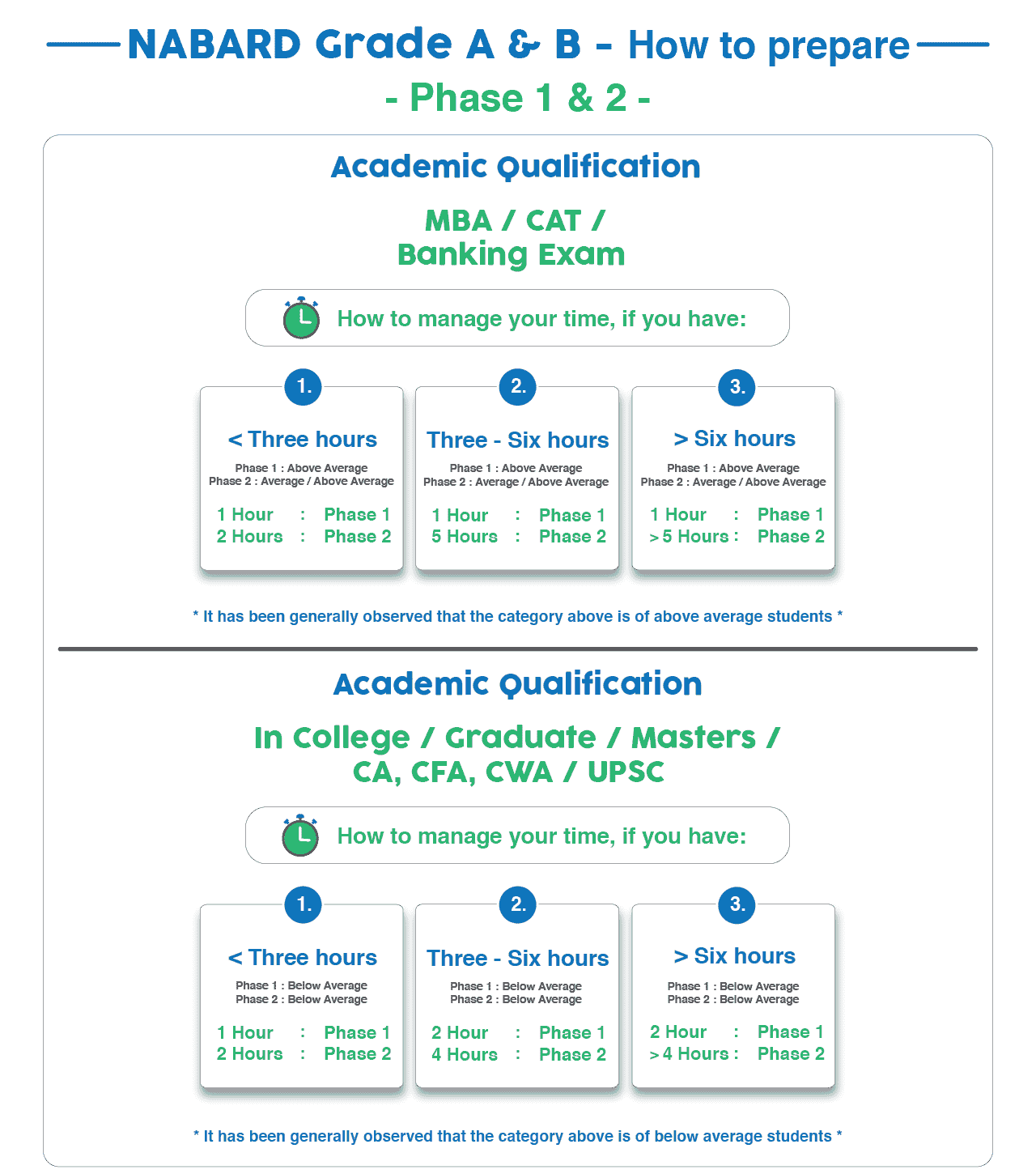
You finally know the number of hours you need to give to each phase based on your current preparation.
In the image below you can check the suggested study sequence for NABARD Grade A & B:
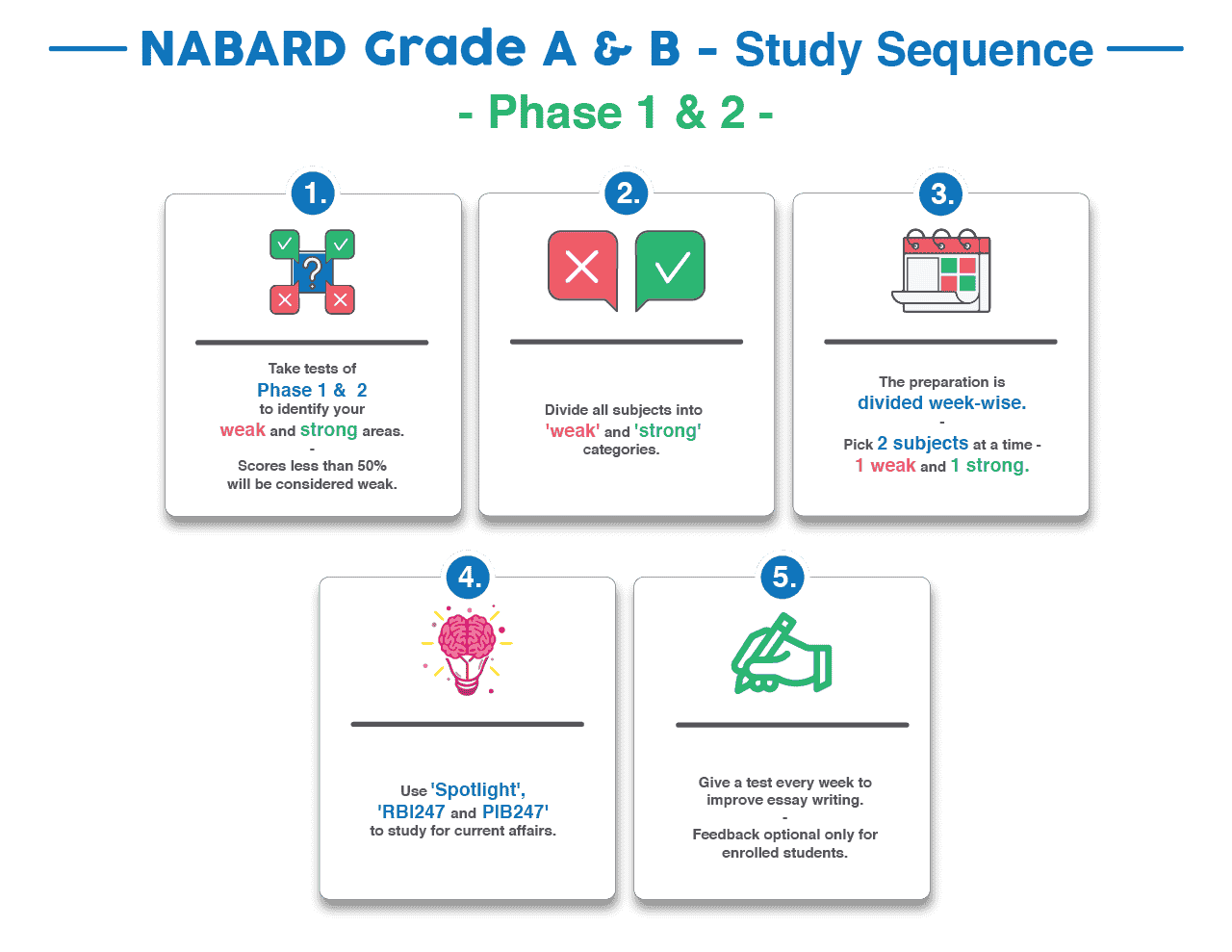
NABARD Grade A 2025 Books
To prepare for NABARD Grade A 2025 exam, the candidates must have a reliable booklist to effectively complete the syllabus for the exam.
Therefore, in this section, I will be helping you out with the various books out there that you can use to cover the Grade A Syllabus 2025.
The books suggested below for NABARD Grade A are the same that should be used to cover the respective sections of Grade B as well.
Now it’s time to find out a way to cover this huge syllabus and clear its cut offs. To know more about NABARD Grade A cut off you can check the link attached.
There are hundreds of books out there but I have handpicked some for you to cover the syllabus. There is no single book to cover the Grade A & Grade B syllabus.
Each subject has different books and it is most likely that you need to read 2-3 books for each subject. I know it is a lot but you it’s helpful in clearing the exam.
Right?
So let’s talk about NABARD Grade A & Grade B Books for different sections and subjects.

RBI, SEBI & NABARD Phase 1 Question Book with Previous Year Papers
₹ 599
Best Books for NABARD Grade A – Reasoning Ability, Quantitative Aptitude, and English Language
Earlier, I used to recommend a mix of popular books like Arun Sharma, Banking Services Chronicles (BSC) publications, and TIME material (originally meant for CAT) for NABARD Grade A Phase 1 preparation.
But over time, I realized that aspirants needed a book tailored specifically for NABARD. So, I wrote one myself – “Phase 1 & Past Years’ Questions Book.”
This book is designed to meet the exact needs of NABARD Grade A aspirants preparing for Phase 1, including:
- 850+ pages with 2000+ MCQs
- Complete coverage of the Phase 1 syllabus along with previous year papers
- Detailed explanations provided for every question to help you learn as you practice
- Each chapter is divided into three levels – Easy, Medium, and Difficult – to help you progress step-by-step
Whether you’re just starting out or aiming to level up your prep, this book offers a structured and focused approach to mastering Phase 1.
| Best Books for NABARD Grade A 2025 | |
|---|---|
| Subjects | Books & Study Material |
| 1. General Awareness |
• Current Affairs & Spotlight • Financial Express or Livemint • Monthly Magazines like Banking Services Chronicles |
| 2. Computer Knowledge | • Computer Awareness – Arihant Publication • Objective Computer Knowledge and Literacy – Kiran Publication • Kiran’s Objective Computer Knowledge and Literacy |
| 3. Quant, Reasoning & English (QRE) | • Quant, Reasoning and English for RBI, SEBI and NABARD Exams – Anuj Jindal• Quantitative Aptitude for Competitive Examinations – S. CHAND
• A Modern Approach to Verbal and Non-Verbal Reasoning – S. CHAND • Objective General English – SP Bakshi • Newspaper such as The Hindu, The Times of India, Indian Express for vocabularies, grammar etc. |
| 4. Economic and Social Issues (ESI) | • Indian Economy NCERT 11th
• Macroeconomics NCERT 12th • Indian Economy - Ramesh Singh • Indian Economy - Uma Kapila (Performance and policies) • Indian Economy – Nitin Singhania • Social problems in India - Ram Ahuja • Indian Polity - Laxmikanth • Economic survey for the year • Union Budget • Pratiyogita Darpan Indian Economy yearly version discharged after Union Budget • NITI Aayog recent reports – selective |
| 5. Agriculture and Rural Development (ARD) | • Objective Agriculture – • S.R. Kantwa – New Vishal Publications
• Fundamentals of Agriculture (Volume 1 & 2) - Arun Katyayan • For Agricultural Field Officer IBPS-SO Book – Jain Brothers • Agriculture Current Affairs – New Vishal Publications • General Agriculture – Muniraj Singh Rathore – Jain Brothers • A Competitive Book of Agriculture – Nem Raj Sundra • Agricultural Census provided by the Ministry of Agriculture. • PIB Releases, i.e., Press Releases by Agriculture and Rural Department. • Geographical knowledge of States and Soils present in those areas. • Cover the Report provided by the Ministry of Environment, Forest, and Climate Change. • Kurukshetra and Yojana Magazines with a focus on the Agriculture part in these Magazines. • Cover the basics of ARD from the book by R.K. Sharma – Agriculture at a Glance. • Go through the Reports provided by • Ministry of Agriculture • Ministry of Rural Development • NABARD Website • State of Forest Report which is provided Bi-annually by the Ministry of Environment, Forest and Climate Change. |
| 6. Decision Making | • Decision Making Essentials – Mark Koscinski |
NABARD Grade A 2025 Mock Test Series
If you are planning to prepare for NABARD Grade A 2025 exam, then I can’t stress enough how much importance mock tests hold for NABARD Grade A exam.
The practice of solving mock tests would help in assessment of your preparation level as it will provide an insight about your strengths and weaknesses, time taken to complete the paper as well as analysis of your conceptual understanding about the topics given in the syllabus.
The NABARD Grade A mock tests not only help you practice but will give you an experience of the real exam.
Benefits of Solving NABARD Grade A & B Mock Test Series
Solving NABARD Grade A & B Mock Test Series will be extremely vital for your success in the exam.
It should not only be important before you are done with the syllabus but also after that. I listed down the benefits of solving the NABARD Mock tests below.
- Solving the Free NABARD Grade A Mock Tests will help you sharpen your knowledge about the exams, and this holds even more true, towards the end of your preparation.
- Practicing on Mock tests will help you gain an instinctive understanding of how to solve the entire NABARD paper well before the exam duration, and that too with the highest possible efficiency.
- Since, the NABARD exams have negative markings in both phases. Therefore solving the NABARD Grade A and B mock test series will train you to avoid making silly mistakes in the actual exams.
- The greatest benefit of solving Mock tests is that you’ll get to identify the topics and subjects you are strong at and the ones you are weak at. That way you can work on your weaknesses more, and also further hone the areas you are already strong at.
Conclusion
In conclusion, understanding the importance of exam pattern is very crucial for effective preparation.
With that, I have compiled all the details regarding the NABARD Grade A & B 2025 exam pattern, selection process, syllabus, books, mock tests, and preparation tips for the exam on this page.
I hope you find this information important and helpful for your exam preparations. I wish you success as you prepare and excel in the exam.
All the best!!

About Anuj Jindal
━━━━━
Anuj Jindal, the founder, is an ex-manager from SBI, with an M.Com from Delhi School of Economics. He also has a JRF in Commerce & Management and NET in HRM, along with more than 5 years of experience in the field of Education.
FAQs: NABARD Grade A & B 2025 Exam Pattern, Syllabus, Mock Tests, Books, and Preparation Strategy
- What is the NABARD Grade A syllabus 2025?
- The NABARD Grade A syllabus for Phase 1 which is objective in nature comprises of 8 sections such as Reasoning Ability, English Language, Computer Knowledge, Quantitative Aptitude, Decision Making, General Awareness, ESI & ARD.
- For Phase 2 which is both objective and descriptive in nature, it consists of 2 papers – Paper 1 General English and Paper 2 ESI & ARD section.
To check the syllabus of these 8 sections in detail, read the relevant section given above.
- Is there any negative marking in the exam?
Yes, there is a negative marking in the exam. For every wrong answer, you will lose 25% of the marks assigned for the question.
So, suppose a question is of 2 marks, then answering it wrongly would set you back by 0.5 marks.
- What type of questions are asked in the mains exam?
Paper I of the mains exam is descriptive type. General English comprises questions from essay writing, comprehension, report writing, paragraph writing & letter writing.
As far as paper 2 of the mains exam is concerned it contains objective-type questions from the subjects of Economics and Social Issues, and Agriculture & Rural Development.
To know more about the selection process and exam pattern you can check the details about the same above.
- How can I prepare for the Interview round?
For the interview round, two things are really important for you to prepare. First one is the biodata form which you submit to NABARD before the interview as it contains all your personal, academic and professional information. The second one is the generic questions which I have mentioned on the page above.
- Is there sectional timing in NABARD Grade A?No, there is no provision of sectional timing in the NABARD Grade A examination. For Phase I exam, the total time duration is of 2 hours to attempt 200 questions. Regarding the exam for Phase II, the duration of 90 minutes is allotted to complete 65 questions.
- What are the benefits of attempting NABARD Grade A mock test?Practicing the NABARD Grade A mock tests provides many benefits for the aspirants. Some of these benefits are as follows:
- Solving mock tests would help to provide a clearer understanding of the exam.
- The negative marking allotted for incorrect answers would help in minimizing errors and avoid silly mistakes.
- The mock tests will prove beneficial in improving efficiency of the candidate for completing the paper within the time limit.
- It assists in providing an assessment of the candidate’s strengths and weaknesses.
- What are the best books for NABARD Grade A Exam 2025?For the examination of NABARD Grade A 2025, some of the best books include:
- Indian economy by Ramesh Singh
- Computer Awareness – Arihant Publication
- Objective Agriculture – S.R. Kantwa – New Vishal Publications
- Indian Economy- Uma Kapila (Performance and policies)
- For Agricultural Field Officer IBPS-SO Book – Jain Brothers
To get access to the complete booklist for NABARD Grade A exam, you can refer to the linked page.