
UPSC Eligibility Criteria 2027 – IAS Age Limit, Qualification, Nationality, Attempts

Anuj Jindal / 15 min read / Last Updated: October 22, 2026
Topics Covered: UPSC Eligibility Criteria 2027, Nationality, Age Limit, Age Relaxations, Educational Qualification, Number of Attempts, Restrictions on Applying, and Medical & Physical Standards
The UPSC Civil Service examination is one of the most reputed and popular exams held in the country.
“To achieve great things, you must deserve before you desire”, and the truth of this statement applies when preparing for an exam like UPSC CSE.
You see, while hard work is a necessary aspect in the preparation for the UPSC exam, just like other entrance exams, it is important for candidates to check their suitability for the exam in the first place.
Yes, you have guessed it right, I am talking about UPSC eligibility criteria.
There are many aspects that comprise the UPSC eligibility criteria which include minimum educational qualifications required to sit for the exam.
The UPSC eligibility also comprises the age limit and total number of attempts, which shall help you become aware of the available time. So that you can prepare well for the exam.
Well, have no worries as I will discuss all the aspects related to UPSC eligibility criteria 2027 in a comprehensive and structured manner.
This shall help you give a clear picture and solve your all doubts whether you are suitable to appear for the UPSC CSE 2027 before you decide in your mind to prepare for the same.
Key Takeaways –
➤ Aspirants do not need a minimum percentage for UPSC CSE exams, unlike any other regulatory body examination. Just a bachelor’s degree from a recognized university is required.
➤ Officers that are currently positioned as IAS/IFS cannot reappear for the UPSC CSE exams, and IPS officers can appear but cannot opt for IPS again.
Table of Content – UPSC Eligibility Criteria 2027 for IAS Exam
1. UPSC Exam Eligibility
1.1 Age Limit
1.1.1 Age Relaxations
1.1.2 PwBD Age Relaxations
1.1.3 Ex-Serviceman Age Relaxations
1.2 Educational Qualification
1.2.1 Important Points for Qualification
1.3 Number of Attempts
1.4 Nationality
1.5 Restrictions on Applying
2. Medical & Physical Standards
2.1 Physical Standards
2.2 Medical Examination
| UPSC IAS Eligibility Criteria | |
|---|---|
| Age Limit | 21 to 32 years (must not have touched the 32nd year) |
| Age Relaxation | OBC - 3 years SC/ST - 5 years PwBD - 10 years |
| Educational Qualification | Graduation (Bachelor) |
| Number of Attempts | General - 06 OBC & PwBD - 09 SC/ST - Unlimited |
| Nationality | Indian Citizens Only |
What is the UPSC Exam Eligibility Criteria 2027?
The official notification for UPSC CSE 2027 will be released on 23rd January 2027. The notification contains details related to UPSC eligibility criteria, which include age limit, educational qualifications, and nationality.
The UPSC Exam Eligibility provides the basis of the criteria that a candidate must fulfill to appear for the UPSC CSE exam 2027.
Here’s a quick overview of the basic UPSC eligibility you should be aware of before applying for UPSC CSE 2027:
- Age limit: – 21 to 32 years
- Educational qualifications: – Bachelor’s degree (graduation).
- Nationality: – Indian citizen.
In addition, there are certain criteria’s for candidates who are already serving in government posts or have previously appeared for the exam, which they have to follow. These criteria are mentioned in detail in the full notification.
The link to the official PDF with complete and updated IAS eligibility criteria is attached here.
Next, let’s go deeper into the age limit for UPSC and understand how it applies to different categories.
What is the UPSC IAS age limit?
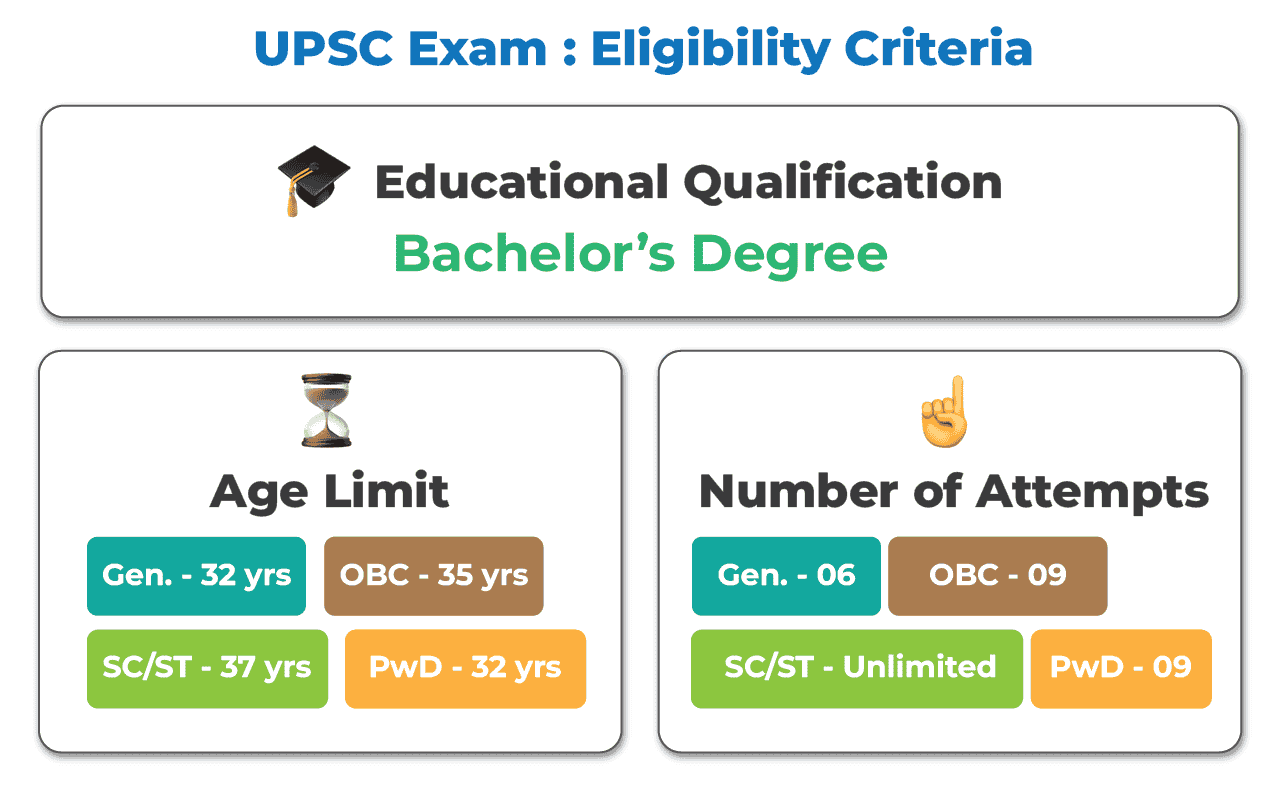
The age limit is a crucial part of the UPSC exam eligibility requirements. According to the UPSC eligibility criteria 2026 as of 01st August 2026, the age limit for candidates belonging to different categories is as follows:
- General: The age limit is 21 to 32 years for the General applicants.
- OBC: For the OBC category, the age relaxation is up to a maximum of 3 years. The age limit is 21 to 35 years for OBC candidates.
- SC/ST: The candidates who belong to the SC or ST category, there is an age relaxation of up to a maximum of 5 years. The age limit is 21 to 37 years for candidates from the SC/ST category.
- PwBD: The age limit is 21 to 42 years for the PwBD category.
To provide you with an example, in order to apply for UPSC CSE 2026, the candidate must have been born not earlier than 02nd August 1994 and not later than 1st August 2005.
UPSC IAS Age Relaxation
| Category | Minimum Age | Relaxation | Maximum Age |
|---|---|---|---|
| General | 21 Years | No Relaxation | 32 Years |
| OBC | 21 Years | 32+3 Years | 35 Years |
| SC/ST | 21 Years | 32+5 Years | 37 Years |
| Physically disabled (Blind, Deaf-mute, Orthopedically handicapped) | 21 Years | 32+10 Years | 42 Years |
| Ex-serviceman discharged from duty due to disability | General: 21 Years | 32+3 Years | 35 Years |
| OBC: 21 Years | 32+3+3 Years | 38 Years | |
| SC/ST: 21 Years | 32+3+5 Years | 40 Years | |
| Ex-serviceman discharged after 5 years duty | General: 21 Years | 32+5 Years | 37 Years |
| OBC: 21 Years | 32+5+3 Years | 40 Years | |
| SC/ST: 21 Years | 32+5+5 Years | 42 Years |
For the various categories of SC/ST/OBC/others, various age limit relaxations have been provided which we will look into in the subsequent section.
While understanding the age limit helps you assess the time you have to prepare, it’s equally important to know what to prepare. You can check the detailed UPSC syllabus to get clarity on the subjects and topics covered in both Prelims and Mains.
What is the Age Relaxation for the PwBD Category in UPSC?
An aspirant with a 40% benchmark disability can be eligible under the PwBD category in the UPCS CSE exams for age relaxation. This section will include aspects of the PwBD category, such as maximum age relaxation and types of disabilities.
The following are a few disabilities that you can check to determine if you belong to any:
- Blindness and Low Vision
- Deaf and Hard of Hearing
- Locomotor Disabilities
- Autism, Intellectual Disability, Specific Learning Disability, Mental Illness, Multiple Disabilities, including deaf-blindness.
For any other disability, verify if it belongs to the Rights of Persons with Disabilities Act, 2016 (RPwD Act, 2016).
Age Relaxations
UPSC provides PwBD aspirants up to 10 years of age relaxation in the upper age limit, which can be combined with other age relaxations as well in case the aspirant belongs to another category as well.
Check below for the maximum age relaxation a PwBD candidate can get:
- General + PwBD: PwBD candidates who belong to the general category get an age limit of 42.
- OBC + PwBD: The upper age limit becomes 45 years, combining 3 years of OBC relaxation with 10 years of PwBD relaxation
- SC/ST + PwBD: The upper age limit extends to 47 years, as candidates receive 5 years of SC/ST relaxation along with 10 years of PwBD relaxation.
Important notes for the PwBD category
- If the candidate is also an Ex-serviceman, relaxation can be added cumulatively.
- Even if the candidate already has a disability certificate, UPSC will conduct a mandatory medical examination.
- Final eligibility for appointment will depend on whether the candidate meets the required disability standards as well as medically fit for the allocated service.
- PwBD candidates are required to have a disability certificate in the prescribed format before the application’s closing date.
After confirming whether you fit into the eligibility criteria, you need to apply for the examination through the UPSC’s official portal, which you can learn step-by-step by clicking here.
What is the Age Relaxation for Ex-Servicemen in UPSC CSE?
Aspirants who have served in the Indian Armed Forces and meet the eligibility criteria prescribed by the UPSC can apply under the Ex-servicemen category for age relaxation in the UPSC CSE exam. This section includes the maximum age relaxation, eligibility conditions, and important points regarding Ex-servicemen benefits.
Here is a list of categories of candidates eligible under the Ex-servicemen provision:
- Ex-servicemen who have completed at least 5 years of Military Service
- Commissioned Officers and Emergency Commissioned Officers (ECOs)
- Short Service Commissioned Officers (SSCOs)
- Defence Services Personnel disabled during operations in a foreign country or a disturbed area
Age Relaxations
UPSC provides eligible Ex-servicemen up to 5 years of age relaxation in the upper age limit. This relaxation can also be combined with other category-based relaxations if the aspirant belongs to the SC, ST, OBC, or PwBD categories as well.
Check below for the maximum age relaxation an Ex-serviceman candidate can get:
- General + Ex-serviceman: Ex-servicemen belonging to the general category can get an upper age limit of 37 years.
- OBC + Ex-serviceman: The upper age limit becomes 40 years, combining 3 years of OBC relaxation with 5 years of Ex-servicemen relaxation.
- SC/ST + Ex-serviceman: The upper age limit extends to 42 years, as candidates receive 5 years of SC/ST relaxation along with 5 years of Ex-servicemen relaxation.
- PwBD + Ex-serviceman: The upper age limit becomes 47 years, combining 10 years of PwBD relaxation with 5 years of Ex-servicemen relaxation.
Important Notes for Ex-servicemen Category
- Candidates must have served at least 5 years of Military Service as on 1st August 2026 to claim age relaxation benefits.
- Ex-servicemen released on completion of assignment, with physical disability attributable to military service, or invalided, are eligible for relaxation.
- ECOs and SSCOs with extended service beyond five years are also eligible if certified by the Ministry of Defence for civil employment.
- The certificate must confirm if the candidate can apply for civil employment and will be released three months after receiving the offer of appointment.
You can check the exam dates for UPSC 2027 by referring to the latest notification for UPSC CSE.
With that, the section of UPSC Age Limit 2027 comes to an end. Now, let’s move to another aspect of eligibility criteria, which is the UPSC Educational Qualification.
What is the UPSC IAS minimum educational qualification?
To be eligible for the UPSC CSE, a candidate must meet the basic IAS qualification, which includes having a graduation degree from a recognized university.
This minimum educational requirement ensures that all applicants have an academic background necessary for the exam.
Whether you’re in the final year of your graduation or have already completed your degree, it’s important to check if you meet the educational qualification criteria before applying for the UPSC exam.
| UPSC Education Qualification 2027 | |
|---|---|
| Exam | Qualification |
| Civil Service Exam | • You should have a bachelor’s degree certificate recognized by the govt or possess an equivalent qualification. • In the case that you possess a professional or technical bachelor’s degree like BE or MBBS recognized by the govt, you’d be considered eligible to appear for the UPSC exam. |
To appear for the UPSC Civil Services Examination (CSE) 2027, candidates must fulfill the educational qualification criteria. As per the UPSC CSE exams guidelines, aspirants are required to have at least a bachelor’s degree from
- A university established by the central or state government of India.
- Any Institute established by an Act of Parliament
- Or a university that has been recognized as a “Deemed University” under section 3 of the (UGC) University Grants Commission Act, 1956
If you want to cover the important topics for the CSE syllabus, you can check the recommended books for the UPSC Prelims and UPSC Mains booklist.
Regarding the eligibility criteria, there are some exceptions in the educational qualifications that the candidates must be aware of:
📌Anuj Jindal Insights
- UPSC allows final year students to apply for the examination if they can get their Graduation Certificate by the Mains stage.
Important Points to Consider for Educational Qualification
- Final year of your graduation –
- In case you are in your final year of college or are intending to appear for the final examination of your bachelor’s degree course, and are awaiting the results of the same, you are eligible to apply for the prelims exam of the CSE.
- In case you clear the UPSC prelims round and are planning to appear for the Mains exam, you’d need to produce proof of your graduation by attaching your bachelor passing certificate to your application for the Mains exams.
- Graduation from other universities – In exceptional cases, the UPSC may allow you to appear for the IAS exams even if you do not have a graduation degree from the universities as listed above but have passed your final year exam from any other institute, the standard of which is approved by UPSC to appear for the CSE.
- Technical and Professional Qualifications – If you possess professional and technical qualifications which are recognized by the govt. as equivalent to professional and technical degree, you will be eligible for this exam.
- Final exam of MBBS/ Medical course– In case you have passed the final exam of your MBBS course or any other medical course but are yet to complete your internship, then:
- You will still be provisionally allowed to appear for UPSC Mains, if you submit a copy of the certificate from your university/institute of having passed the final medical exam along with your application.
- In this case, you need to possess an original degree or a certificate from your university attesting that you have completed what is needed (including the completion of internship) for the award of the degree during the Interview round.
To know more about the nature of examination, you can take a look the UPSC previous year question papers.
That concludes this section, let’s move to the section on the number of attempts.

How many attempts are allowed for the UPSC CSE Exam?
For candidates belonging to different categories, the provision for number of attempts to sit for UPSC exam is as follows:
- General category – Maximum 6 attempts are provided
- OBC category – Maximum 9 attempts are given
- ST/SC category – Unlimited number of attempts are granted.
- PwBD –
- General/ OBC: Maximum 9 attempts are granted.
- ST/SC categories: Unlimited number of attempts are given.
To provide a better perspective, I have mentioned all the information about the number of attempts in the table below.
| UPSC Number of Attempts 2027 | |
|---|---|
| Category | Maximum Age (should not have touched the age of:) |
| General | 6 |
| OBC | 9 |
| SC/ST | As many as he/she can until upper age limit reached |
| Physically disabled | General: 9 attempts |
| (Blind, Deaf-mute, Orthopedically handicapped) | OBC: 9 |
| SC/ST: As many as he/she can until upper age limit reached | |
| Ex-serviceman discharged from duty due to disability | As per categories mentioned above, i.e., Gen, OBC, SC/ST, Disabled |
| Ex-serviceman discharged after 5 years duty | As per categories mentioned above, i.e., Gen, OBC, SC/ST, Disabled |
Knowing more about trends in UPSC cutoff in last few years will help you assess the difficulty level of this exam.
Who Can Apply for the UPSC IAS Exam Based on Nationality Criteria?
To appear for the UPSC IAS exams you need to be a citizen of India, for all other services, you must be either:
- A citizen of India,
- Or a subject of Nepal,
- Or a subject of Bhutan,
- Or a refugee from Tibet that came to India before the 1st of January 1962 with the intention of settling in India permanently.
- Or an individual with Indian origin who has migrated from Burma, Sri Lanka, Pakistan, East African countries of Uganda, Zambia, Zaire, Kenya, the united republic of Tanzania, Malawi, Ethiopia, & Vietnam, with the purpose of settling permanently in India.
Note:
- If you belong to categories b), c), d), and e), then you’d need a certificate issued by the govt. of India to be eligible.
- Also belonging to the b), c), d), and e). Categories will bar you from being eligible to be appointed to the Indian Foreign Services.
Eligibility of Certificate
Note: In case, you are required to produce an eligibility certificate from the government, you will still be allowed to appear for the exam. But the appointment will only be confirmed after you submit the aforenoted eligibility certificate issued by the Govt. of India.
You can check the IAS Officer Salary to know details like allowances, salary structure and perks associated with the job.
📌Anuj Jindal Insights
- Indian citizens can apply for all services, while citizens of Nepal or Bhutan and Tibetan refugees are eligible only for services other than IAS and Indian Foreign Service.
UPSC IAS Eligibility Criteria: Restrictions on Applying for the Examination
- If you are already appointed to the Indian Administrative Services (IAS) or Indian Foreign Services (IFS) on the result sheets of an earlier exam and also continue to be a member of any of the 2 services, then you will not be eligible to appear in the exams that particular year.
- If you are already appointed to the Indian Police Services (IPS) on the result sheets of an earlier exam and continue to be an IPS officer, then you will not be eligible to opt for the IPS in the exams for the particular year.
You can also check the UPSC preparation page for Commerce & Management which I have provided to help you prepare for the exam effectively.
What are the UPSC IAS Medical and Physical Standards?
Candidates who are shortlisted for the Personality Test (Interview) must go through a mandatory medical examination.
This process ensures that future Indian Administrative Service (IAS) officers are physically and mentally fit to handle the responsibilities of the role.
While much focus is given to written exams and the interview, understanding the medical standards is equally important for aspirants.
You must make sure that you are physically fit and capable enough to take on the role of an IAS officer. For that, you’d need to meet all the physical standards for admission to the Civil Services Examination, 2027.
These standards are decided on as per the guidelines given in Appendix-III of Rules for Examination published in the Gazette of India Extraordinary.
Physical Standards for IAS
The IAS does not have strict physical requirements like minimum height, weight, or chest measurements. However, candidates must be in generally good health, with proportionate physical features. Any abnormalities or concerns may lead to further medical evaluation such as:
- Height, Weight, and Chest:
The medical board looks for proportionality and any significant imbalances may require further checks like chest X-rays or hospitalization. - Vision Standards:
- Distant Vision: 6/6 or 6/9 in the better eye.
- Near Vision: J1 or J2 depending on the eye.
- Candidates can use corrective measures like glasses, contact lenses, LASIK, ICL, or IOL surgeries.
- Myopia with macular degeneration is disqualifying. Squint and night blindness are not disqualifying.
- Color Vision: A good level of color perception is required.
- Hearing Ability:
Candidates must have normal hearing in both ears. Hearing aids or surgical correction are allowed if they bring hearing within acceptable limits. - Abdominal and Musculoskeletal Health:
The body should be free from deformities or conditions affecting movement or physical capability. Issues like joint stiffness, limb abnormalities, or stomach disorders may need treatment or further evaluation. - Other Medical Conditions:
- Grade I hemorrhoids are acceptable.
- Hernia, hydrocele, varicose veins may result in temporary disqualification until treated.
- Candidates with malignancies or organ transplants (except corneal) are generally disqualified.
📌Anuj Jindal Insights
- The medical standards are more flexible than many aspirants assume. Distant vision should be 6/6 or 6/9 in the better eye, and glasses, contact lenses, LASIK, ICL and IOL are allowed.
- However, conditions like myopia with macular degeneration and poor colour vision can lead to disqualification.
- If you have any medical concerns, getting a pre-medical check-up at a government hospital can help you know your eligibility before starting your UPSC journey.
Medical Examination Process
The medical examination is conducted at designated government hospitals in New Delhi such as Safdarjung, AIIMS and more. It includes a comprehensive health check across several areas:
- General Physical Examination:
Height, weight, BMI, blood pressure, and pulse rate are measured. - Eye Examination:
Tests for visual clarity, depth perception, and color vision. Use of glasses or corrective surgery is permitted within set limits. - Hearing Test:
Assesses auditory function. Candidates with hearing loss must meet criteria with or without hearing aids. - Blood and Urine Tests:
Routine tests to check for diabetes, infections, kidney function, and overall health. - Chest X-ray and Lung Examination:
Checks for lung diseases such as tuberculosis or chronic respiratory issues. - Heart and Circulatory System:
Includes ECG and blood pressure checks to evaluate heart function. - Orthopedic and Musculoskeletal Evaluation:
Assesses bone structure, joint mobility, and the presence of deformities. - Neurological and Psychological Screening:
Evaluates mental health, cognitive abilities, and any signs of neurological disorders. - Additional Tests (if needed):
Further tests may be advised based on prior medical history, disability, or findings during the initial examination.
While the IAS does not enforce strict physical standards like some other services, overall physical and mental fitness is essential. Candidates are encouraged to be aware of these requirements and take necessary medical precautions early in their preparation journey.
Conclusion
With this, we have come to the end of the page. I have provided a detailed explanation of UPSC eligibility criteria, including the minimum educational qualifications to help you ensure your suitability for the exam.
Apart from this, I have also mentioned the age limit for the UPSC age limit and the total number of attempts to make you aware of the time left to prepare your best for the exam.
All the best and keep learning!!

About Anuj Jindal
━━━━━
Anuj Jindal, the founder, is an ex-manager from SBI, with an M.Com from Delhi School of Economics. He also has a JRF in Commerce & Management and NET in HRM, along with more than 5 years of experience in the field of Education.
UPSC CSE – Related Resources
Anuj Jindal RBI Grade B Course:
- 2027 Live Batch with Live Doubt Sessions
- 30-Day Live Revision Batch
- 3 Physical Practice Books
- 1 to 1 Interview Guidance Programme
- 250+ Videos Lessons & 150+ Notes
- 2500+ Practice Ques. + 60 Full-Length Tests
- Comprehensive Current Affairs coverage

FAQs: UPSC Eligibility Criteria for IAS Exam
- How many attempts can I give for the UPSC exam?
The total number of attempts is allotted to candidates based on different categories, which are as follows:
- Candidates belonging to the General category can appear for a maximum of 6 attempts.
- The maximum number of attempts for candidates from the OBC category is 9,
- For candidates from SC/ST/ PWD category, there is no limit on the number of attempts till their respective upper age limits.
- What are the UPSC Educational Qualification Requirements?
Applicants must hold a Bachelor’s degree from a recognized central, state, or deemed university; final-year undergraduate students are also eligible to appear for the prelims provisionally.
- What is the Age Limit for UPSC General category candidates?
For UPSC, General and EWS category candidates must be between 21 and 32 years of age as of 1st August of the examination year, with no upper age relaxation applicable.
- Are there any age relaxations in UPSC for female candidates?
No, for the UPSC exam, female candidates are not granted any kind of age relaxation. However, women are exempted from the exam fee in the application process.
If you want to know about the age relaxation criteria of the UPSC, you can check it out in the article I have written above.
- What is the age limit for the UPSC Exam 2027?
Talking about UPSC age limit 2027, the applicants are required to meet the following criteria:
- The minimum age limit required to appear for the IAS is 21 years for candidates of all categories. Whereas the maximum age limit for candidates belonging to different categories is specified as follows:
- The upper age limit for candidates from General category is 32 years.
- The maximum age for candidates from OBC category is 35 years.
- The age limit for SC/ST category candidates is 37 years.
- Whereas the uppermost from candidates from PwBD category is 42 years.
- Is there any reservation for ex-servicemen in the Civil Services Exam?
- Yes, there are reservations for ex-servicemen in the Civil Services Exam. As per the UPSC exam eligibility, the upper age limits of ex-servicemen are extended by a few years.
- The maximum UPSC age limit criteria for ex-servicemen have been divided between two different categories of ex-servicemen.
- The first being “Ex-serviceman discharged from duty due to disability” and the other being, “Ex-serviceman discharged after 5 years duty”.
- For category of “Ex-serviceman discharged from duty due to disability”, the upper age limit for General candidates is 35 years, for OBC, it is 38 years, and for SC/ST, it is 40 years.
- For category of “Ex-serviceman discharged after 5 years duty”, the upper age limit for General candidates is 37 years, for OBC, it is 40 years, and for SC/ST, it is 42 years.
- Is a diploma holder eligible for UPSC?
No, a diploma holder is not eligible to appear for the UPSC Civil services exam, as the UPSC candidates must have at least a graduation degree before applying for the exam.
- Can 12th passed students apply for the UPSC recruitment?
No. It is not possible for a 12th passed student to apply for the IAS exam, as the minimum educational qualification required by UPSC is a bachelor’s degree from a government-recognized university.
You can take a look at the process of the UPSC apply online.
- Is there a minimum percentage required in graduation for the IAS exam?No, there is no minimum percentage needed to score in your graduation as you only require a Bachelor’s degree from a government recognized university. It includes any technical or professional degree recognized by the government like B.Tech, BE or MBBS.